This is default featured post 1 title

Go to Blogger edit html and find these sentences.Now replace these sentences with your own descriptions.This theme is Bloggerized by Lasantha Bandara - Premiumbloggertemplates.com.

This is default featured post 2 title

Go to Blogger edit html and find these sentences.Now replace these sentences with your own descriptions.This theme is Bloggerized by Lasantha Bandara - Premiumbloggertemplates.com.

This is default featured post 3 title

Go to Blogger edit html and find these sentences.Now replace these sentences with your own descriptions.This theme is Bloggerized by Lasantha Bandara - Premiumbloggertemplates.com.

This is default featured post 4 title

Go to Blogger edit html and find these sentences.Now replace these sentences with your own descriptions.This theme is Bloggerized by Lasantha Bandara - Premiumbloggertemplates.com.

This is default featured post 5 title

Go to Blogger edit html and find these sentences.Now replace these sentences with your own descriptions.This theme is Bloggerized by Lasantha Bandara - Premiumbloggertemplates.com.

Showing posts with label Google News. Show all posts

Wednesday, March 10, 2010

Why towns are saying 'Try Me' to Google

Communities across the country are going gaga over Google.

With hopes of becoming a test bed for the online search giant's ultra-fast Internet network
, Topeka, Kansas, temporarily changed its name to Google.

Duluth, Minnesota, created a spoof YouTube video mocking Topeka's effort, pledging to rename every first-born male Google Fiber and female Googlette Fiber.

Highlands Ranch, a suburb south of Denver, is gathering community members to form a human "We Love Google" sign at a local high school football stadium.

"We know we have to do something unusual to get Google's attention," said Jamie Noebel, community-relations manager for Highlands Ranch.

Google announced plans last month to a build a fiber-optic network that would offer residential Internet speeds of 1 gigabit per second - about 100 times faster than the speeds available to most Americans today.

Put another way, users would be able to download a high-definition movie
in less than a minute, compared with more than an hour on speeds currently available.

The company said the service may reach up to 500,000 people and asked communities interested in becoming a trial location to essentially submit an application by March 26. Google says it will weigh factors such as "community support, local resources, weather conditions, approved construction methods and local regulatory issues."

The test community or communities will be selected this year.

Google has long had a testy relationship with traditional broadband providers, battling over issues such as "network neutrality" - an effort to prevent companies such as Comcast and Denver-based Qwest from offering tiered pricing for access to their networks.

Google doesn't necessarily want to be an Internet service provider. It's using the "experiment" to show that faster broadband speeds can be offered by companies other than cable and telecommunications firms.

"We'll manage our network in an open, nondiscriminatory and transparent way," Google states on the project's Web page.

Google will have to dig up roads and connect fiber-optic cables directly to homes, similar to the network upgrade Verizon has undertaken in its local phone-service territory.

By working directly with local governments, Google can cut some of the red tape that often slows such buildouts, such as right-of-way issues.

And city officials across the country are showing they're more than willing to work with Google.

Longmont in northern Colorado is quick to note that the city owns its own electric utility, giving Google easy access to infrastructure it may need to roll out the service.

"There's a lot of hype out there, but once you get through the hype, we've got a lot of attributes," said Tom Roiniotis, director of Longmont Power & Communications.

He said the St. Vrain Valley School District is planning a YouTube video contest to promote Longmont, which also owns an 18-mile fiber-optic ring that Google can tap into.

NDtv News

Tags: google, google experiment, topeka kansas, Google News, Google Community, Google Fiber, Googlette Fiber,

Tuesday, February 23, 2010

Google Buzz | Google rolled out a new social media platform called Google Buzz | social networks


Since Google Buzz has already attracted a lot of attention and controversy, it has become inevitable that we takes you on a tour around Google's new social networking tool.

Google rolled out a new social media platform called Google Buzz. If you have a Gmail account - if you don't have, you can have it one by filling this form - you might have noticed a new tab marked "BUZZ" when you signed in into your inbox.

Google Buzz , which is the new service that served up bu Google, is another way to start conversations about the things you find interesting.

Google Buzz is similar to other social networks such as Twitter, Facebook, MySpace, Bebo etc.

Google Buzz that allows you to use it only with your Gmail account is being popular among the internet users. With Google Buzz, you can easily and quickly post links and check what your friends (contacts) are up to.

Google Buzz Video:


Tags: Google, Google Buzz, Twitter, Facebook, Social Networking sites, My Space,

Tuesday, January 5, 2010

Google's new phone to protect mobile advertising base | Google's New Phone |


Google has said it is defending its online advertising empire with the launch of its own brand mobile phone.

It is the first time Google has designed and sold its own consumer hardware device.

Google said the Nexus One represented the next frontier in the company's $20bn (£12.4bn) core business - selling advertising through search.

"It's all about the mobile web, and advertising is their bread and butter," said analyst Michael Gartenberg.

"It's the latest salvo from Google on the wireless industry. The landmark news here is that Google is now a consumer electronics retail company," added Mr Gartenberg, of Interpret.

Google, like many in the industry, recognises that more and more people are accessing the web via their mobile phones rather than through their desktop or personal computers.

In the developing world, the majority of users are going online for the first time using a smartphone.

"The new paradigm is mobile computing and mobility," David B Yoffie, a professor at Harvard Business School, told the New York Times.

"That has the potential to change the economics of the internet business and to redistribute profits yet again."

Apple 'cool' fading?

Google has called the Nexus One a super phone, no doubt to set the device apart from the other players, including the BlackBerry and Apple's iPhone.

Despite its much anticipated arrival on the scene, many industry watchers do not think the Nexus One is an iPhone killer, though they do believe it will force Apple to step up its game.

"Google is coming at the mobile industry with a lot of horses and I think 2010 is the first time Apple is going to have to chase something," said technology blogger Robert Scoble of Scoblizer.com.

iPhone
Some think Apple's iPhone may be losing its cool factor

"For the last three years the iPhone has been way out in front in the mobile space in terms of mindshare. The Nexus One means this will be the first time Apple has to be reactive," Mr Scoble told the BBC.

To date, the iPhone has sold about 30 million units and spawned countless imitators, including this new phone.

The technology blog TechCrunch said that the Nexus One looked more like the iPhone than any other phone on the market.

There is no physical keyboard, it has a removable battery, a 5 megapixel camera, touchscreen, and is driven by Google's Android operating system.

Google says the phone is as thin as a number 2 pencil, at 11.5mm, and as light as a Swiss army knife keychain at 130g.

"The Nexus One is an important milestone in the smartphone market," said TechCrunch founder Michael Arrington.

"This is a software company frustrated with making compromises with hardware manufacturers, that has taken the product bull by the horns. When combined with Google Voice, there is no phone on the market today that can touch the Nexus One."

Google has voice-enabled all text boxes on the device, which means that users can put together an e-mail message or tweet by speaking into the phone rather than typing text on the touch screen.

Pricing models

As well as going into the hardware business, Google is also trying out something different by offering the phone to users without being tied to a contract with a mobile phone operator.

It is offering the Nexus One through its online store at $179 (£112) if users sign up to a two-year plan with T-Mobile, or $529 (£332) without a plan.

Screengrab of Nexus One page, Google
Google will host a web store that will sell the Nexus One

Some believe Google should have been braver with its pricing options and offered a sweetener by subsidising the phone through its advertising revenue.

"It would have been nice to see them roll out something a bit more unique," Danny Sullivan, editor of SearchEngineLand.com, told BBC News.

"Google has speculated in the past that there one day might be phones that are entirely ad-supported and because Google is this huge ad behemoth, this was a natural opportunity to roll out a phone like that."

The Nexus One was built by Taiwanese electronics manufacturer HTC.

It joins about 20 other devices that already run on the Android operating system.

At the moment, the Nexus One is only available in the US but will be sold in Europe, Hong Kong and Singapore in the spring through Vodafone. Google said it hoped to add other devices and carriers for sale in the future.

Crossover

Google's emergence as a retailer is regarded as an escalation in the budding rivalry between Google and Apple.

But it is not all one way.

Ahead of the launch of the Nexus One, Apple announced a deal to buy mobile advertising service Quattro Wireless. It is seen as an effort to counter Google's planned $750 million acquisition of rival AdMob.

"If there is any doubt that 2010 is the year of Mobile Advertising, Apple just cleared up any speculation," said Paran Johar, chief marketing officer of competing mobile ad network Jumptap.

"For pessimists who thought the Google acquisition of Admob was a fluke, this reinforces that mobile advertising is here to stay," he said.

"Handset manufacturers, software providers, infrastructure vendors, and carriers are all looking to connect the dots and carve out a share of what will be the primary access point of the Internet in five years."

Source: http://news.bbc.co.uk/2/hi/technology/8442712.stm

Sunday, January 3, 2010

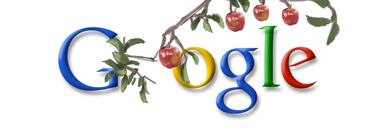
Isaac Newton and falling Apple on Google today | Google Remembers Isaac Newton With An Animated Doodle


Today Google has changed their logo and placed Apples on it. If you go to the Google homepage, you’ll notice the logo above along with an animated falling Apple. Google created this logo to celebrate the birth date of Sir Isaac Newton. Newton is famous for his three laws of motion, which I will list below.

* Newton’s First Law states that an object at rest stays at rest and an object in motion tends to stay in motion unless acted upon by an external force.
* Newton’s Second Law states that an applied force on an object equals the rate of change of its momentum with time.
* Newton’s Third Law states that for every action there is an equal and opposite reaction.

Google always has a reason they include things in their logo. Why is an logo with a falling Apple on the Google home page? Well, that’s because a falling apple from a tree inspired him to formulate his theory of gravitation.

Tags: isaac newton biography, isaac newton birthday, isaac newton quotes, sir isaac newton, albert einstein

Friday, December 4, 2009

The World's Largest Copyright Infringer is Google?

With such harsh current rulings against the world's many torrent sites, one company is heavily profiting from the types of searches which are responsible for over 60% of all global searches. Google, valiantly remains the world's largest torrent indexer, although some choose to disagree. The debate on Google remains as disputable as any argument, although some of us know, that the unfair war against the torrent site's, is being heavily over-looked against Google.


 For those who do not understand how Google violates the same "regulations" that are being "alleged" as being broken by the torrent and warez sites, let me explain. The Google Bot spiders the logs of every site, and the bot then spiders all the previous searches (urls with arguments) and Google indexes them. Thus using Google, you can access tons of claimed "copyright" infringing torrents.

So why is it okay for Google to do this? Well, some would claim Google does not host the alleged infringing files on their servers. True, but neither do torrent sites. A torrent site works as a search engine, merely pointing you in the proper location. The only files that are uploaded to torrent sites, are small, BitTorrent files, which provide torrent clients the ability to know who has the said files, by pinpointing a swarm into the proper direction, and allowing one to access that which they are looking for. Torrent files themselves are in no way, shape, or form, illegal, or violate any copyright laws.

So Google, continues to lead the world as the most visited website, even though it's been proven that at least 75% of all internet traffic, is used for file sharing. They profit daily, from ad revenue, that can be seen on the same pages, as indexed searches of copyrighted material. In some nations though, torrent sites under fire, have legally demanded this topic be further reviewed by the courts, before allowing torrent sites to receive all the fire, simply for lack of understanding how it all works.

Just recently, Isohunt, has broughtit before the attention of the anti piracy outfits in Canada. IsoHunt Web Technologies Inc, the company behind the IsoHunt Bittorent search engine, has delivered a case against the Canadian Recording Industry Association (CRIA) in front of a British Columbia court, raising questions about whether search engines are liable for the sharing of copyrighted material. Isohunt delivered the case outline in court after the company received legal threats from the legal threats from the Recording Industry Association of America (RIAA) and CRIA.

The courts must now decide, whether infamous search engines such as Google, Yahoo, or Bing, which also return search queries linking in "alleged" copyrighted materials, are breaking the same copyright laws as the advocates for anti piracy claim that the IsoHuner web site does. In front of the legal system, Isohunt's attorneys demonstrated to the court, that Google can be used search for the same files that are also being found on sites like Isohunt. The only thing that torrent sites do differently, is that torrent sites are used specifically to find BitTorrent files, while Google searches all file extensions.

None the less, Google, still the world's largest search engine, is not being charged for doing the same thing that smaller torrent indexers do, allow users to search for copyrighted material. Becoming an "enabler" for the access of illegal materials. Isohunts's Gary Fung has stated, "It's disappointing to see CRIA wanting to unnecessarily complicate our well defined petition, in attempt to bog us down with time and money through messy discovery and in the process the court's time too.".

Google, Yahoo, MSN, and other major search engines could be engaged in a legal battle in Canada for returning search queries related to copyrighted material. Or maybe it will be overlooked yet again. If in fact it is over-looked, then it's time for someone to announce the hypocrisy of the anti piracy outfits. In fact, to this date, Google has linked more users to copyrighted materials, then all torrent sites combined.

Some can defend Google yes, and say it doesn't have the intent to link to copyrighted materials, where as torrent sites do. No, that claim is outrageous as well, where as torrent sites are meant to link you to useful "legal" materials, and help it's users find them with ease. There are lots of products that are not considered copyright violations, that you can find via torrent sites.

Google could easily defend itself against rather unmatched opponents such as the industry led anti piracy advocates. It's brand is worth over a hundred billion dollars. It's awfully hard to compete in trial against a company with the finances to defy and obliterate you, and the industry moguls know this.

Not only do they know Google is a multimedia powerhouse, but it's also a direct financer of many Hollywood production companies, and their owner's personal business ventures. Also, a new tool from Google was introduced, allowing locked DRM releated videos to be sold from it's online store. Google Video, delivers in a securely locked format, in which restricts how Google members are able to use and view the videos which they have purchased. Such forms of security, are known as a Digital Rights Management system (DRM). DRM is also used by many Google's competitors, and other forms of entertainment, for the purpose that it is unlike any other copyright system that is currently in place. Instead, it enforces a single method of how copyright should work, and forces it to be used by Google's customers.

So it seems, as long as you "appease" the companies whom are pursuing the copyright liability claims, that you can continue to gain profit doing the same things. As long as you have the financial backing to bend the rules, then it's okay by all means in the eyes of anti piracy outfits. In the process of violating the same regulations set forth for torrent sites, Google not only continues to do the same thing, but it also sits back unaffected as it's competition in searches, the torrent sites, are shut down, one by one.

In a modern age, where some torrent sites are forced to inflict copyright filters, and others have their service providers threatened with charges, it would seem, that Google would also have to follow the regulations. What ever happened to, all for one and one for all? Should one company be allowed to continue the same illegitimate business practices, while others are forced closed? Absolutely not. The hypocrisy of such actions, are visible to us all. I only hope that some who's vision on this matter was blurred, now can see this with eyes wide open.


Tags: Google Copywriter, Google Copyright, Google Copyrighting, Google Infrigment, Google Copyright Infringer

Friday, November 20, 2009

Google Chrome OS Unveiled: Speed, Simplicity, and Security Stressed


Google demonstrated for the first time its Google Chrome OS, a Web-centric operating system set to be officially released late 2010.

From left to right: Sergey Brin Google co-founder, Matt Papakipos, Google engineering director, and Sundar Pichai, Google VP of product development.

Google opened its doors to the press Thursday to show off its hotly anticipated Chrome operating system for the first time. In a small auditorium in Mountain View, California, Google VP of Product Development Sundar Pichai took to the stage to give us a demonstration of what Chrome OS actually is. Some rumors were confirmed, others dispelled, as the operating system emerged into the light of day. Here's what we now know about Google's Chrome OS.

"As of today, the code will be fully open," Pichai said. In fact, shortly before the press event began, the unofficial Google OS blog announced public availability of the Chrome OS source code. With this code now in the hands of the open source community, it shouldn't be long before various builds of the code end up trickling onto the Web.

Chrome OS vs. Browser

To explain why Google decided to take on the OS project in the first place, Pichai put the project into context of the existing Chrome Web browser, which now has more than 40 million users worldwide. The browser is currently available only for Windows, though Mac and Linux versions will be available before the end of the year. "The Mac version is nearly ready," said Pichai, who is using it as his primary browser on his own machine.

In addition to new versions for Mac OS X and Linux, Google is nearing the release of browser extensions like those found on Firefox and Internet Explorer. One differentiating point is that Chrome extensions will be automatically updated by the browser, simplifying the process of keeping your favorite extensions working when the browser is updated, which is an issue that currently frustrates many users of mainstream browsers.

HTML5 is a core driver behind Google's Chrome OS strategy. "We're all used to running rich games on our personal computer. We wanted to be able to run the same rich games in the browser," Pichai said. An important facet of HTML5 is that it allows Web apps to address the PC's processor and other hardware resources to run 3-D graphics, video, and audio locally on the PC, and address local storage. Perhaps surprisingly, Google has also been working with other browser vendors to increase support for HTML5.


Chrome OS

According to Pichai, one of the principal motivations behind creating a Chome operating system is speed. Pichai repeatedly alluded to Google's desire to make the computing experience more like a TV viewing experience in both simplicity and speed. "From the time you press boot, you want it to be like a TV," he said. "Chrome on Chrome OS will be even faster than Chrome." The meaning here is clear: Google wants to build an instant-on device that lets users get on the Web as quickly as they could turn on a TV. But it also means the company is pushing to make a more streamlined OS that requires less hardware and includes fewer background processes that eat into system resources.


Click Here for MORE PICTURE GALLERY >>

To Read More here... http://www.pcworld.com/businesscenter/article/182655/google_chrome_os_unveiled_speed_simplicity_and_security_stressed.html

Share

Twitter Delicious Facebook Digg Stumbleupon Favorites