This is default featured post 1 title

Go to Blogger edit html and find these sentences.Now replace these sentences with your own descriptions.This theme is Bloggerized by Lasantha Bandara - Premiumbloggertemplates.com.

This is default featured post 2 title

Go to Blogger edit html and find these sentences.Now replace these sentences with your own descriptions.This theme is Bloggerized by Lasantha Bandara - Premiumbloggertemplates.com.

This is default featured post 3 title

Go to Blogger edit html and find these sentences.Now replace these sentences with your own descriptions.This theme is Bloggerized by Lasantha Bandara - Premiumbloggertemplates.com.

This is default featured post 4 title

Go to Blogger edit html and find these sentences.Now replace these sentences with your own descriptions.This theme is Bloggerized by Lasantha Bandara - Premiumbloggertemplates.com.

This is default featured post 5 title

Go to Blogger edit html and find these sentences.Now replace these sentences with your own descriptions.This theme is Bloggerized by Lasantha Bandara - Premiumbloggertemplates.com.

Showing posts with label USA News. Show all posts

Thursday, February 18, 2010

Public disgusted by Mayor Mike Bloomberg, President Barack Obama and rest of the 'in' crowd: Poll

A spate of new polls shows no one is immune from this season's rising tide of voter disgust - not President Obama, not Mayor Bloomberg, not City Council Speaker Christine Quinn, not anyone.

"Welcome to the new public game show - it's called 'Hate the Incumbents,'" cracked political consultant Hank Sheinkopf.

"The good news for most of them is they don't have to face reelection anytime soon," Sheinkopf added. "But those who do may not be in control of their own destinies."

http://assets.nydailynews.com/img/2010/02/18/alg_bush_obama_bloomberg.jpg

The bad news starts at the top, where President Obama would be booted from the Oval Office if he faced reelection today. Just 44% of Americans would vote for him, compared with 52% who would prefer someone else, a CNN/ORC survey found this week.

The President's biggest problem is the economy, which helped put him in office when it tanked under President George W. Bush but now has become an anchor around his administration's neck, surveys suggest.

Obama did his best yesterday to put a new gloss on his $787 billion stimulus bill, which was signed into law a year ago.

"Our work is far from over, but we have rescued this economy from the worst of this crisis," Obama said.

The news is better, but still not great, for Bloomberg.

Hizzoner's approval rating has fallen to 61% - a healthy majority but still his lowest point in 41/2 years, a new Quinnipiac University poll found yesterday.

That's down from 67% in September and 75% in October 2008. The last time Bloomberg dipped so low was July 2005, when he had a 60% approval rating heading into his first reelection bid.

"For Mayor Mike, 60 is the new 70," Quinnipiac's Mickey Carroll said. "The man who cruised through his second term with 70% approval ratings should be happy if he can stay above 60% in his third term."

Other city leaders fare worse.

Quinn has a 44% approval rating after four years of running the Council. New Controller John Liu also is at 44%, and new Public Advocate Bill de Blasio has a rating of 37%.

Controversial Schools Chancellor Joel Klein is more loathed than loved: 39% of voters approve of the job he's doing, and 40% disapprove.

Obama can take heart in one number - if this whole White House thing doesn't work out, he might want to consider running for mayor of New York in 2013.

The President's approval rating in deep blue New York remains at 72% - an enviable number for other pols. Still, his disapproval rating shot up to 25%.

White House spokesman Robert Gibbs said it was understandable that people's outlook is not rosy, given the depth of the recession inherited by the White House.

"It's understandable the frustration that the American people feel about the direction of their economy, based on what we've gone through since December 2007," Gibbs said, adding that the recovery act created about 2 million jobs to "fill in a hole that was 8.4 million jobs deep."


NYdaily News
Monday, February 15, 2010

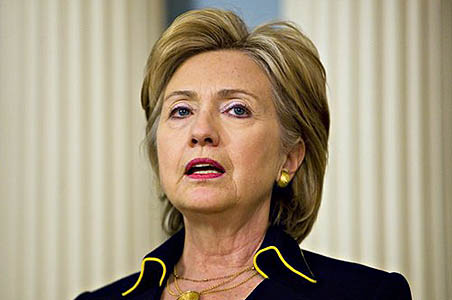
US fears Iran headed for military dictatorship | Secretary of State Hillary Rodham Clinton said Monday

The United States fears that Iran is drifting toward a military dictatorship, Secretary of State Hillary Rodham Clinton said Monday, with the Islamic Revolutionary Guards Corps seizing control of large swaths of Iran's political, military and economic establishment.


Clinton encouraged Iran's religious and political leaders to rise up against the Revolutionary Guards, coming as close as any senior administration official has to inviting political upheaval in the country.

"That is how we see it," Clinton said at a televised town-hall meeting of students at a
university in Doha, Qatar. "We see that the government of Iran, the supreme leader, the president, the Parliament is being supplanted and that Iran is moving toward a military dictatorship."

Her blunt comments carried particular resonance because of where they were delivered, in Qatar, a Persian Gulf emirate with close ties to Iran, and later in the day, in Saudi Arabia. But they built on the administration's strategy of branding the Revolutionary Guards as an "entitled class" that is the principal culprit behind Iran's nuclear proliferation and political repression.

The United States is tailoring a new set of stricter U.N. sanctions aimed at the Revolutionary Guards, which Clinton said had accelerated its marginalization of religious and political leaders since the Iranian presidential elections in June.

Iran's leading clerics and political figures must "take back the authority which they should be exercising on behalf of the people," Clinton said at a news conference after a nearly four-hour meeting with King Abdullah of Saudi Arabia at his desert camp outside the capital, Riyadh.

It was an intense day of diplomatic barnstorming by Clinton. In public meetings and private talks, she carried her message about the Revolutionary Guards into the heart of the Middle East, trying to win over ambivalent neighbors like Qatar, and fire up Iran's critics, chiefly Saudi Arabia.

Clinton also said that the United States would protect its allies in the Gulf from Iranian aggression, a pledge that echoed the notion of a "security umbrella" that she advanced last summer in Asia. She noted that the United States already supplied defensive weapons to several of these countries, and was prepared to bolster its military assistance if needed.

Clinton may have made some headway, given the response of the Saudi foreign minister, Prince Saud al-Faisal. He said Iran risked setting off a nuclear arms race in the region, and expressed worries that the U.S.-led effort to impose new sanctions might not come quickly enough.

"Sanctions are a long-term solution," he said. "But we see the issue in the shorter term, maybe because we are closer to the threat. So we need an immediate resolution rather than a gradual resolution."

Saud also appeared to encourage China, the main holdout to sanctions, to back a Security Council resolution. Saudi Arabia's influence with Beijing is significant, given that it is China's largest supplier of oil and could offset any retaliatory cutoff of shipments from Iran should Beijing support sanctions.

U.S. officials have prodded Saudi Arabia to reassure China, and while they would not say whether they had been successful, they said they were encouraged by Clinton's meeting with the king.

As Clinton made her rounds, General David H. Petraeus, the commander of the Central Command, arrived here for talks about military cooperation with Saudi Arabia. He is to be followed in a few days by the chairman of the Joint Chiefs of Staff, Adm. Mike Mullen.

"We will always defend our friends and allies, and we will certainly defend countries who are in the Gulf who face the greatest immediate nearby threat from Iran," Clinton said in Doha.

Qatar is one of four Gulf states - along with Kuwait, Bahrain and the United Arab Emirates - that have recently acquired additional anti-missile defense systems from the United States, military officials said.

Pressed by an audience of students, most of them Muslim, at the Doha campus of Carnegie Mellon University, Clinton said the United States had no plans to carry out a military strike against Iran.

Still, as the Obama administration moves from diplomacy to pressure, its policy is edging closer to the hard line toward Iran that Clinton advocated as a presidential candidate. At times on this trip, her public comments have sounded a lot like her words on the campaign trail.

Asked about the so-called security umbrella, a phrase Clinton first used during the Democratic primary and which the White House did not embrace after she mentioned it in Thailand last summer, she said she still believed it was the best way to counter the Iranian threat.

Iran's neighbors, she said, have three options. "They can just give in to the threat; or they can seek their own capabilities, including nuclear; or they ally themselves with a country like the United States that is willing to help defend them," she said. "I think the third is by far the preferable option."

In singling out the Revolutionary Guards, the administration is also trying to drive a wedge between ordinary Iranians and what it sees as a privileged and corrupt ruling class.

"I think the trend with this greater and greater military lock on leadership decisions should be disturbing to Iranians, as well as to those of us on the outside," Clinton told reporters as she flew from Qatar to Saudi Arabia.

Last week, the Treasury Department froze the assets within its jurisdiction of four companies controlled by the Revolutionary Guards, as well as of a commander, Gen. Rostam Qasemi, who oversees the guards' construction and engineerijg0aonglomerate, Khatam al-Anbiya.

White House officials have begun what they say will be a "systematic" effort to target holdings of the Revolutionary Guards, which in addition to its nuclear involvement, also has a record of supporting militant Islamist organizations and cracking down on protesters.

Previous Security Council resolutions have designated a handful of senior figures in the Iranian nuclear program, including the man believed to run much of the military research program for the Revolutionary Guards. But the administration's latest push would name and apply sanctions to an array of companies.

The goal would be to increase the cost for those who do business with Iran so much that they would cut off ties.

But in prodding the clerics and politicians to take action, Clinton found herself in the awkward position of celebrating the early days of the Islamic Revolution. Iran today, she said, is "a far cry from the Islamic republic that had elections and different points of view within the leadership circle."

Share

Twitter Delicious Facebook Digg Stumbleupon Favorites